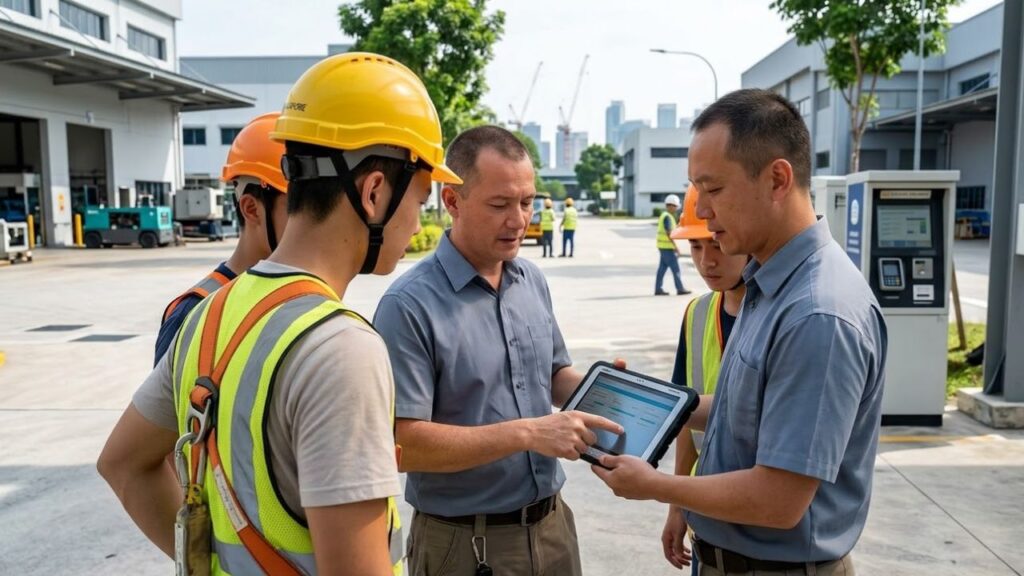
In 2026, Singapore will change the rules for Work Permits that affect employers who hire foreign workers in important industries. The changes are mostly about changing taxes setting, quotas for workers and, and making rules that protect workers more strongly.
Companies that hire migrant workers should read the new rules as soon as possible to avoid problems with compliance.
| Update on Policy Area 2026 | Submitting online through the MOM portal |
|---|---|
| Tax on Foreign Workers | About S$300 to S$950 a month, depending on the sector and how many quotas are used. |
| Health Insurance | At least S$60,000 in coverage for each worker every year |
| Validity of Work Permit | Usually lasts up to two years |
| System for Applications | Submitting online through the MOM portal |
| Rules for Housing | Workers must stay in places that have been approved. |
A look at Singapore’s work permit system
A Singapore Work Permit lets semi-skilled foreign workers from certain countries work in fields that are short on workers.

Some common areas are:
- Building things Manufacturing
- Shipyard for ships
- Industry of process
- Sector of services
The Work Permit is different from other passes because it doesn’t have a set minimum salary requirement. However, employers must follow strict quotas levies and, and welfare standards.
The permit is usually good for up to two years and must be sponsored by an employer in Singapore.
Important Changes to the Rules for Work Permits in Singapore in 2026
1. Changed the structure of the foreign worker levy
Employers who hire migrant workers have to pay a monthly fee called the foreign worker levy.
From 2026 on, the levels of the levy will still depend on the sector and the dependency ratio.
Important points are:
- Companies that go over their workforce quotas have to pay more taxes.
- Lower levy levels for workers with more skills
- Monthly taxes that range from S$300 to S$950
This pricing structure makes companies want to hire fewer low-skilled workers and get more done.
2. New Dependency Ratio Ceiling (DRC)
The Dependency Ratio Ceiling (DRC) says how many foreign workers a company can have on its staff at most.
Rules for renewing a work permit in Singapore in 2026
Rules for renewing a Singapore work permit in 2026: who can do it, medical checks, and how long it lasts
Expected limits are:
Maximum Ratio of Foreign Workers by Sector
- Up to 87.5% for construction
- Up to 60% of manufacturing and up to 35% of services
- Up to 87.5% in the Process Industry
Businesses that go over these limits can’t hire more people with Work Permits.
Before sending in applications, employers should check their quota status.
3. Better housing and worker welfare standards
Worker welfare is still a top priority in Singapore’s labor policy.
According to the rules for 2026, employers must make sure that
- Medical insurance that covers at least S$60,000 a year
- Living in approved dorms or regulated housing
- Following safety rules at work
The goal of these requirements is to make workers healthier and lower the risk of public health problems.
4. More focus on skills and getting things done
Singapore keeps telling businesses to hire more skilled workers.
Policy direction for 2026 includes:
- Benefits for hiring migrant workers with more skills
- Backing for automation and the use of new technologies
- Training programs to help workers get more done
Employers who pay for training for their workers may be able to get better levy tiers or government grants.
5. Applying for a digital work permit and following the rules
The Ministry of Manpower (MOM) digital system is the only place where you can apply for a Work Permit.
Some important digital processes are:
Money Help for Seniors in SG
Silver Support Scheme 2026: Money Help for Seniors in SG
- Submitting an application online
- Renewals of electronic work permits
- Tracking payments for the levy
- Records of digital workers
These systems make it easier for employers to follow the rules.
 Singapore Senior Bonus for 2026: Expanded Cash Support and New Payment Window for Eligible Citizens
Requirements to Get a Singapore Work Permit (2026)
What Workers Need
People who want to apply must:
- Be at least 18 years old
- Come from countries that are on the list of approved sources
- Meet the skill needs of the sector
- Pass medical tests
- Have never broken any immigration laws before
Depending on the rules of the sector, workers often come from Malaysia China India Bangladesh, Thailand, and Myanmar.
What Employers Want
Employers who hire people with work permits must:
- Run a business that is registered in Singapore
- Stay within the DRC’s limit on foreign workers.
- Pay the foreign worker tax that is due
- Give approved housing
- Buy health insurance
Employers are also responsible for the costs of sending workers back home when their job ends.
How to Apply for a Work Permit in Singapore
Step 1: The employer sends in the application
The employer uses the MOM online portal to apply and gives:
- Information about the worker’s passport
- Field of work and job
- Information about company quotas
Step 2: Approval in Principle (IPA)
The employer gets an In-Principle Approval (IPA) letter if the application is approved.
This lets the worker legally enter Singapore.
Step 3: The worker gets to Singapore
After they arrive, the worker must do the following:
- Checkup
- Registration of fingerprints and photos
Step 4: Get a Work Permit
After meeting all the requirements, the worker gets a Work Permit card, which lets them work legally.
Punishments for Not Following the Rules
Singapore has strict rules about work.
Dates for payments from the Silver Support Scheme 2026
Eligibility rules, payout dates, and quarterly payments for the Singapore Silver Support Scheme 2026
If employers break the rules for work permits, they may face:
- Fines
- Not being able to hire foreign workers
- Revocation of Work Permit
- Legal action
Some common violations are:
- Illegal work
- Not paying the levy
- Bad housing for workers
- Not having health insurance
Why This Is Important
Singapore’s construction, manufacturing, and service industries depend heavily on foreign workers. The changes to the 2026 Work Permit are meant to keep the economy competitive while also protecting workers’ rights.
Employers can avoid expensive fines by learning about levy costs and quota limits early on. Stronger rules about insurance and housing make it safer and easier for workers to do their jobs.
To stay compliant, you need to keep an eye on policy updates from the Ministry of Manpower.
Questions and Answers
What is the lowest salary you can make to get a work permit in Singapore?
People with work permits don’t have to make a certain amount of money. Pay varies based on the job, the industry, and the employer’s agreement.
How long does a Singapore Work Permit last?
A work permit is usually good for up to two years, but this depends on how long the passport is valid and the employment contract.
Can employers get a Work Permit again?
Yes. Before the permit runs out, employers can use the MOM online system to apply for renewal.
Do employers have to offer insurance?
Yes. Employers must give each Work Permit holder at least S$60,000 worth of medical insurance every year